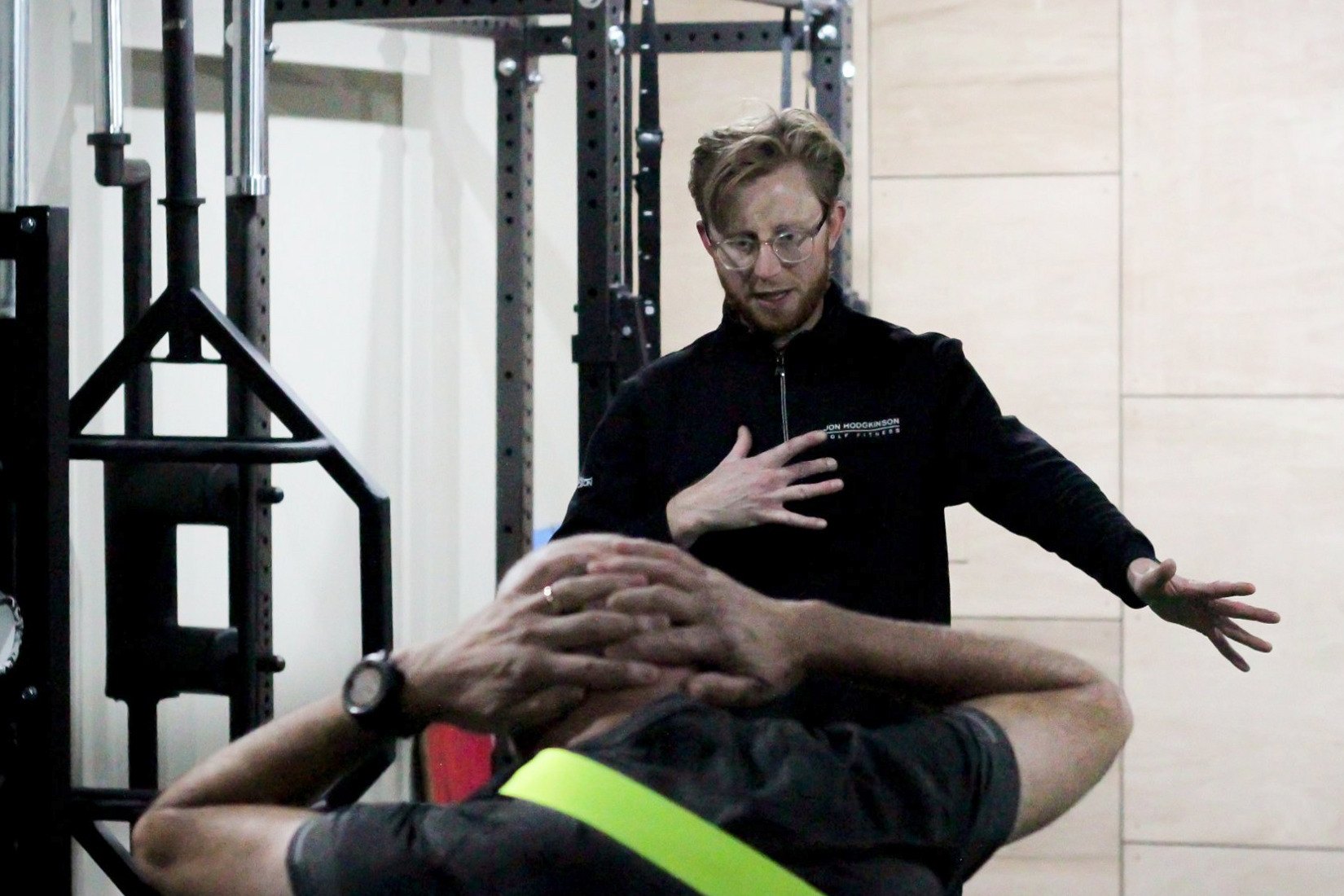
The best golf workout trains what your swing needs: mobility in your hips and upper back, strength in your legs, glutes and core, and the power to turn that strength into clubhead speed.
For most golfers, two sessions a week of about 45 minutes, kept up all year round, is enough to gain distance and lower your risk of injury.
Below is the golf workout plan I'd give most golfers, at three levels: beginner, intermediate and advanced. Pick the one that fits where you are now.
Further down is how to adapt it if you're over 60, short of time, training at home, or have a sore back, knee, hip or shoulder.
I've coached golfers over 50 for more than 15 years and assessed more than 250 of them. My oldest client is 92. Everything here is built for golfers like them.
Does a Golf Workout Actually Help Your Golf?
Yes, and you don't need to train like a tour pro to see it.
In one study, 15 male golfers with an average age of 47 followed an eight-week home program of stretches, resistance band exercises and balance work, three or four times a week. Their club speed rose by about 5% and their carry distance by almost 8%.
In another, golfers who added golf strength training to their week (weights and jumping exercises, twice a week for eight weeks) gained clubhead speed and driving distance. The golfers who carried on as normal showed no real change.
A 2024 review that pooled 20 studies found that lower-body strength, upper-body strength, jumping power and upper-body explosive strength were all linked with faster clubhead speed. Flexibility and balance on their own were not.
That doesn't make mobility a waste of time. Mobility decides whether you can use your strength in the swing.
When a hip won't turn, the body finds another way, and a golfer who should be rotating slides instead. That's why every routine below starts with mobility.
What a Golf Workout Should Include
Every golf workout routine I write follows the same order:
- Mobility. If there's any foam rolling, it's the first thing in the session. Then come the drills that get your hips, upper back and shoulders moving.
- Core and balance. Exercises that stop your trunk being pulled or twisted out of position, so the power from your legs reaches the club, and balance work so you can control the big shifts of weight in the swing.
- Power. Fast, explosive exercises. A few good reps, done while you're fresh, beat a lot of tired ones.
- Strength, always last. A squat or split squat, a hip hinge, and a row or pullover. These build the legs, glutes and upper body that produce speed.
You need all four, in that order. Strength never comes before the power work, and core and balance never come after it.
The Golf Workout Plan: Pick Your Level
There are three routines below: beginner, intermediate and advanced. Each is a full-body golf workout of about 45 minutes, in the same order: mobility, core and balance, power, then strength.
Do yours twice a week, with at least a day between the two sessions.
The three levels follow the way I progress my own clients: control and stability first, then strength, then power.
Which Golf Workout Routine Is Right for You?
- Beginner: you're new to strength training, you haven't trained regularly for a while, or you're stiff and want to start gently. The aim is control and moving well.
- Intermediate: you move well and you've been training regularly. The aim is strength, so the weights go up over time.
- Advanced: you've trained consistently for a long time, you lift with good technique, and stiffness or niggles aren't holding you back. The aim is power, on top of heavier strength work.
If you're not sure, start a level lower. I always start golfers on the easier version of an exercise and build from there.
When to Move Up a Level
Move up when every exercise in your routine feels solid and controlled, not after a set number of weeks. Some golfers move up quickly and others stay at one level for a long time.
For the strength exercises (the last three in each routine), pick a weight you could lift two or three more times. Rest 60 to 90 seconds between sets.
When you can do every set at the top of the range with good form, go up a weight.
These routines aren't a warm-up for the course. Before you play, use my 5-minute golf warm-up instead.
Mobility: The Start of Every Golf Workout
Every routine starts with the same four mobility drills, whatever your level: two with a foam roller, then two seated drills. Muscle release comes first, then the mobility drills.
1. Foam Rolling the Upper Back (Mobility)

Your upper back (the thoracic spine) is one of the key areas that delivers rotation in the golf swing. When it's stiff, you can expect a shorter backswing, less power at impact and more back pain.
Among senior golfers, it's the most common restriction I see in my assessments. Foam rolling it is almost always where I start.
Sit with the roller behind you, around the lower part of your shoulder blades. Put your hands behind your head and tuck your elbows in.
Lift your hips and roll from the top of your shoulders to the bottom of your rib cage, like a rolling pin. This warms up the tissue.
Then go back to your shoulder blades, drop your hips to the floor and arc backwards over the roller, so your upper back moves into extension. Draw back up and repeat a little further down each time, until you reach the lower part of your rib cage.
Do: about a minute.
2. Foam Rolling the Inner Thighs (Mobility)

When a golfer's hips don't turn well, I start by foam rolling the muscles of the inner thigh (the adductors), before the hip drill below.
Lay the roller lengthways in front of you and come down onto your forearms, as in a front plank. Put one leg out to the side, bent to 90 degrees, so the roller sits on the inside of that knee.
Roll slowly in towards your groin and back out towards your knee. When you find a tight spot, stay on it until it releases.
Do: about a minute on each leg.
3. Seated Thoracic Rotation with Breathing (Mobility)

This is my favourite drill for improving rotation through the upper back. You'll notice an immediate and significant improvement in how far you can turn.
Sit on a box, chair or bench with your feet about shoulder-width apart. Put your hands behind your head and drive your elbows out to the sides.
Turn to one side as far as you can, letting your head turn with you. Side bend down towards that side and take a deep breath in, opening up through your rib cage. Then breathe out, draw back up, still turned, and see if you can turn further.
Keep your lower body still. The turn should come only from your upper body.
Do: 5 slow turns each side.
4. Seated Hip Internal Rotation (Mobility)

Hip internal rotation is the inward turn of your thigh at the hip. For a right-handed golfer, the right hip turns inwards in the backswing and the left hip in the follow-through.
If either hip can't, you tend to make up for it with a sway or a slide, or by turning through your lower back instead.
Sit tall on a box, chair or bench, hands either side of it, with a yoga block or something solid between your knees. Turn one hip inwards, towards your pelvis, so your lower leg swings out to the side.
Keep your knee locked in position and rotate from the hip as far as you can. You should feel the top of the hip working.
Do: 8 on one side, then 8 on the other.
Beginner Golf Workout
Start here if you're new to training or coming back to it. The aim is control: holding your trunk steady, balancing on one leg, and moving well through a squat, a bridge and a row.
You need a foam roller, a power band, one dumbbell and a sturdy chair or bench, so it works as a golf workout at home too.
At a glance, after the four mobility drills:
- Tall Kneeling Pallof Press (core): 2 sets of 8 each side
- 3-Point Balance and Reach (balance): 2 sets of 5 rounds on each leg
- Step to Chest Press (power): 2 sets of 5 each side
- Goblet Box Squat (strength): 2 sets of 10 to 12
- Glute Bridge (strength): 2 sets of 10 to 12
- Wide-Stance Row (strength): 2 sets of 10 to 12 with each arm
1. Tall Kneeling Pallof Press (Core)

Your core's main job in the swing isn't to twist. It's to hold your spine steady while your hips and upper back turn around it, so the power from your legs reaches the club.
The Pallof press is one of the best exercises I know for building that and protecting your lower back. Kneeling tall is where I'd start.
Set a power band or cable at mid-torso level and kneel side-on to it, with your knees wide for a good base of support. Draw the band in to the centre of your chest. Slowly press it straight out in front of you, then slowly draw it back in.
The band will try to pull you in towards the frame. Keep your stomach muscles braced and your shoulders and hips level. For more resistance, move further out from the frame.
Do: 2 sets of 8 each side.
2. 3-Point Balance and Reach (Balance)

Most golfers assume their balance is fine because they don't fall over. But your balance has to control big shifts of weight into the backswing and through the ball. When it can't, you lose consistency, accuracy and power.
It's also one of the quickest things to improve.
Stand on one leg with the knee soft, pressing your big toe, little toe and heel into the floor. Imagine you're in the middle of a clock face.
With your free foot, tap the floor straight ahead (12 o'clock) and bring it back to the middle. Do the same out to the side (3 or 9 o'clock), then straight behind you (6 o'clock). That's one round.
Keep your weight over your standing leg, hinged slightly forwards. Your hands can go on your hips or out to the sides.
Do: 2 sets of 5 rounds on each leg.
3. Step to Chest Press (Power)

This is the easier version of a medicine ball chest pass, and it's where I start golfers on rotational power.
Set a cable at chest height. At home, loop a power band around a frame or a door jamb instead. Stand with your feet close together and your hand drawn in to the side of your chest.
Take a big step out, turning 90 degrees and pivoting through your back foot, and press the weight out in front of you. Control it back in to your body and return to where you started.
Do: 2 sets of 5 each side, as fast as you can while staying in control.
4. Goblet Box Squat (Strength)

Strong legs let you push harder into the ground, and that's where clubhead speed starts.
Stand with your heels against a box, bench or chair, feet just outside shoulder width and toes turned out a little. Hold one dumbbell with an underhand grip at the top of your chest. Grip the floor with your feet to create tension through your legs.
Lower slowly, getting your hips deep, until you tap the box. Then drive back up through your feet to stand tall.
Do: 2 sets of 10 to 12.
5. Glute Bridge (Strength)

Strong glutes protect the lower back, help prevent swing faults and produce more speed and power than any other muscle group. The glute bridge is where I'd start building them.
Lie on your back with your feet flat on the floor, about hip-width apart, and brace your stomach muscles. Push your heels into the floor, tuck your pelvis under and lift your hips towards the ceiling, squeezing your buttocks. Hold for 5 seconds, then lower slowly and reset.
Do: 2 sets of 10 to 12.
6. Wide-Stance Row (Strength)

Rows strengthen your upper back and help keep your shoulders healthy. A good rule of thumb is to do twice as many rows as pressing exercises.
Attach a power band to a frame and step back until there's tension on it. Take a wide stance, like a squat stance, with your other hand behind your back.
Stay tall and draw the band slowly in to the side of your rib cage, driving your elbow past your body. Then control it back out.
Don't let the band pull your upper body into a turn. Hold a strong position and keep your body still.
Do: 2 sets of 10 to 12 with each arm.
Intermediate Golf Workout
Move on to this golf workout routine once the beginner exercises feel solid, or start here if you already train regularly and move well. The aim now is strength, so the weights go up over time.
You need a pair of dumbbells, a medicine ball and a solid wall, a power band and, in the gym, the cable machine.
At a glance, after the four mobility drills:
- Pallof Press (core): 2 to 3 sets of 8 each side
- Low to High Cable Chop (core): 2 sets of 8 each side
- Medicine Ball Chest Pass (power): 3 sets of 5 with each leg in front
- Split Squat (strength): 3 sets of 8 to 10 on each leg
- One-Arm Single-Leg Deadlift (strength): 3 sets of 8 to 10 on each leg
- Single-Arm Cable Row (strength): 3 sets of 8 to 10 with each arm
1. Pallof Press (Core)
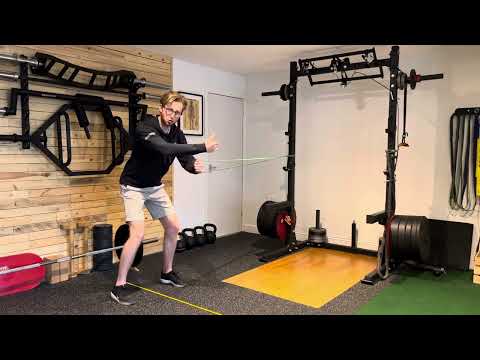
The Pallof press trains your core to hold your spine steady while your hips and upper back turn around it. Attach a band to something secure at chest height (at home, a banister works). Stand side-on to it, slightly behind the band, with your feet outside shoulder width and your knees soft.
Grip the band with both hands at the centre of your chest. Press slowly forwards for a count of three, pause, then bring your hands back in for a count of three. Use your legs and stomach muscles to stop the band turning you.
Do: 2 to 3 sets of 8 each side.
2. Low to High Cable Chop (Core)

Most of the swing's power comes from the lower body, but your core has to pass that power up into your upper body and on into the ball.
The woodchop is my favourite core exercise for golfers of every age, because it builds exactly that rotational strength.
Set the cable on its lowest setting and take a wide stance. Think of the movement in three parts: load, set, press.
Load: turn your outside hip in towards the frame, so you feel yourself load down into position. Set: come back to the centre. Press: drive up and across your body, along a diagonal line from the cable through your hip and pelvis to your outside shoulder.
Keep going through load, set and press, getting more dynamic as you go.
Do: 2 sets of 8 each side.
3. Medicine Ball Chest Pass (Power)

The aim here is speed, not effort. Stand facing a target on a solid wall, with a hand on either side of the ball and your left leg in front.
Hold the ball out in front of you, then load it in to your chest. Extend hard and punch it forwards into the middle of the target. Feel like you're pushing up off the floor a little to drive the movement.
Do: 3 sets of 5 with each leg in front.
4. Split Squat (Strength)

Working one leg at a time trains the smaller muscles that steady you, improves your balance and helps even out differences between your legs.
Hold a dumbbell in each hand and take a staggered stance, like a lunge held still. Come up onto the toes of your back foot.
Staying tall through your upper body, lower your back knee until it gently taps the floor. Drive up through your front leg and reset before the next rep.
Do: 3 sets of 8 to 10 on each leg.
5. One-Arm Single-Leg Deadlift (Strength)
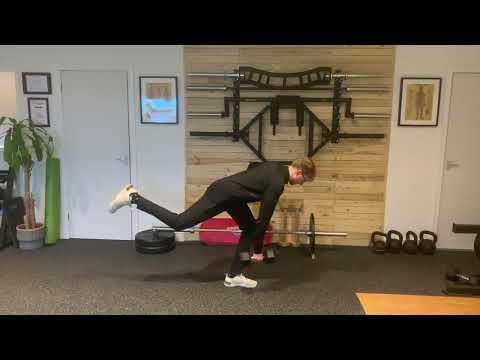
This builds your glutes and your balance together, which matters for a consistent strike. Hold a dumbbell in one hand and stand tall on the opposite leg.
Hinge from your hips, driving your free leg out behind you as your upper body leans forwards. Lower the dumbbell down the side of your thigh to the middle of your shin, keeping your spine in a neutral position. Then drive back up to stand tall.
Do: 3 sets of 8 to 10 on each leg.
6. Single-Arm Cable Row (Strength)

Rows strengthen your upper back and help keep your shoulders healthy.
Set the weight and step back slightly from the frame. Hold the handle in your right hand, with your left foot forwards and your right foot behind you. Put your left hand behind your back and grip the ground with your front foot.
Keeping your chest up, slowly pull your right hand in to the side of your chest. Pause for 2 seconds, then slowly let your arm back out until it's straight.
Your lower body should stay stable throughout.
Do: 3 sets of 8 to 10 with each arm.
Advanced Golf Workout
This golf workout is for golfers who've trained consistently for a long time, lift with good technique and aren't held back by stiffness or niggles. The aim is power: a few fast reps, done while you're fresh, on top of heavier strength work.
You need a power band, a light medicine ball and a solid wall, dumbbells and a bench.
At a glance, after the four mobility drills:
- Split Stance Pallof Press (core): 3 sets of 8 each side
- Medicine Ball Rotational Wall Pass (power): 3 sets of 5 each side
- Lateral Hop to Balance (power): 3 sets of 5 hops each way
- Rear-Foot Elevated Split Squat (strength): 3 sets of 6 to 8 on each leg
- Single-Leg Deadlift (strength): 3 sets of 6 to 8 on each leg
- Pullover (strength): 3 sets of 6 to 8
1. Split Stance Pallof Press (Core)
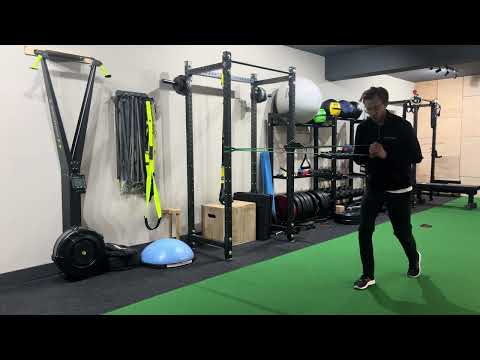
Attach a power band to a frame at about mid-torso height and step out sideways until you feel a little resistance. Take a staggered stance with most of your weight on your front leg. Your back foot is only there to help you stay stable.
Hold the band in both hands at the middle of your chest. Stay tall and slowly press it straight out in front of you, then slowly bring it back. The band is trying to drag you in towards the frame, so use the strength of your trunk to stay steady.
Do: 3 sets of 8 each side.
2. Medicine Ball Rotational Wall Pass (Power)

This trains rotational power: a fast shift of weight and turn of the body, the same things that put power into your swing. Use a light ball. The aim is speed, not effort.
Stand relaxed, facing a wall, with your feet just outside shoulder width and the ball held low. Shift your weight into your left side and release your right foot.
Bring the ball up from low and let it go on the way up, letting your body turn as you release it. Be as dynamic as you can through your lower body.
Do: 3 sets of 5 each side. For the other side, swap left and right.
3. Lateral Hop to Balance (Power)

This trains power from side to side: pushing off one leg and landing under control on the other.
Stand on your outside foot with the knee soft, then push off the floor and hop sideways onto your other leg. Absorb the landing by letting that knee bend into a partial squat. Push off again to hop back, staying light on your feet.
Do: 3 sets of 5 hops each way.
4. Rear-Foot Elevated Split Squat (Strength)

Your legs are where clubhead speed starts, and this loads them one at a time.
Hold a dumbbell in your right hand and rest the top of your right foot on a bench behind you. Over the first couple of reps, find the spot where the top of your ankle sits just off the edge of the bench.
Lower slowly until your right knee gently taps the floor. Drive back up tall, extending through your left leg.
Finish one side before you switch.
Do: 3 sets of 6 to 8 on each leg.
5. Single-Leg Deadlift (Strength)

Strong glutes protect the lower back and produce more speed and power than any other muscle group. Hold a dumbbell in each hand and stand on your left leg with the knee soft.
Slide your right leg out behind you as you hinge forwards, lowering the dumbbells to just below your knee. Drive back up and put your foot down. Keep the tension through the whole movement, using your back foot only as a little stabiliser.
Do: 3 sets of 6 to 8 on each leg.
6. Pullover (Strength)
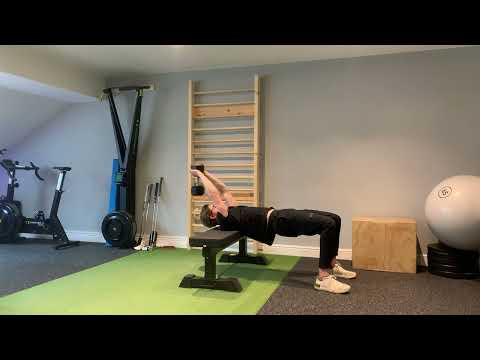
The pullover works your chest and lats (the large muscles down the sides of your back), two of the main upper-body muscles in the swing. It's good for shoulder mobility and stability too.
I think it's one of the best dumbbell exercises a golfer can do.
Sit on a bench set lengthways, then lie back so your shoulder blades and the top of your head are supported. Drive up into a shoulder bridge, pushing through your glutes and keeping your stomach muscles tight.
Hold the dumbbell with an underhand grip and reach it slowly back overhead, until you feel the backs of your arms working. Then brace your stomach muscles and drive it back over to the top, slow and controlled.
Do: 3 sets of 6 to 8.
How Often Should You Do a Golf Workout?
Twice a week is the minimum I'd suggest.
The CDC recommends that adults over 65 do muscle-strengthening activities on at least 2 days a week, working all the major muscle groups, plus activities that improve balance. Doing your routine twice a week covers both.
Both studies above saw results within eight weeks, one with two sessions a week and the other with three or four. If you have time for a third session, do your routine again.
Keep Going Through the Season
I encourage golfers to train all year. The off-season is a good time to start, but progress carries on during the season, and stopping throws away what you've built.
During the season, keep both sessions and keep the power work short and sharp. Don't do your hardest session the day before a round that matters to you.
A Golf Workout at Home or in the Gym
This golf fitness workout works in either place.
In the gym: all three routines work as a golf gym workout. The intermediate routine uses the cable machine for the chop and the row.
At home: the beginner routine needs only a foam roller, a power band, one dumbbell and a sturdy chair or bench. For the intermediate routine, add a second dumbbell, a medicine ball and a solid wall. For the advanced routine, add a bench or sturdy step.
Loop the band around a banister, a frame or a door jamb, as I show in the videos. For the cable row and the chop, fix it at the height the cable would be.
Adapting the Golf Workout
If You're Over 60 or New to Exercise
Start with the beginner golf workout and stay with it until every exercise feels solid. There's no prize for rushing to heavy weights.
Put your legs first. A study of 468 adults found that muscle mass starts to fall noticeably at around 50, and that the loss comes mainly from the lower body. The squats, split squats and deadlifts in these routines are the exercises that work against it.
It isn't too late to start. Gary Player turned 90 on 1 November 2025 and, GOLF.com reported, still goes to the gym as part of his daily routine. As he put it: "I won't fall because my core is sturdy and my legs are strong."
One thing I'd leave out for now is overspeed training (swinging weighted or light clubs as hard as you can). It puts the body under a lot of stress, so it's best kept until your mobility and strength are in good shape. I explain why in the 10 best golf exercises for seniors.
If you'd rather follow a golf workout program from a PDF you can keep on your device, the free seniors workout is made for senior golfers.
Get the free seniors workout
A golf workout made for senior golfers. Download it to keep on your device and refer back to later.
As well as the free workout, you’ll get occasional emails to help you play your best golf. Unsubscribe at any time. Privacy policy
If Your Back, Knee, Hip or Shoulder Hurts
Pain is a reason to change the workout, not to stop moving altogether. These are the swaps I make with my own clients.
They aren't a diagnosis: if something hurts, have it looked at by someone who can examine you.
- Lower back: leave out the power exercises and any heavy split squats or deadlifts. Keep the foam rolling, the hip and upper-back mobility drills, and the Pallof press, seated or kneeling tall as in the beginner routine. My guide to lower back pain in golf goes further.
- Knee: leave out squats, lunges and split squats. Do hip hinges instead, such as glute bridges, hip thrusts and kettlebell deadlifts. See how to fix knee pain.
- Hip: leave out squats, lunges, deadlifts and hip thrusts. Focus on hip mobility drills and band exercises that move your leg out to the side.
- Shoulder: leave out the pullover and anything else that loads your arm overhead, fast shoulder rotations, and pressing to the end of your range. Keep the row, and add gentle band exercises where you hold your shoulder still against the band.
Stop and get checked if you have numbness, tingling, or hot or cold feelings in your legs, or a sharp catching pain in your hip.
If you can get to Dronfield, near Sheffield, Beth at our injury clinic can find where the problem is coming from and treat it hands-on.
If You're Short of Time
Do the four mobility drills, then your routine's Pallof press and its three strength exercises, with 2 sets of each. That's a golf workout of about half an hour, and it still covers mobility, core and strength, in the right order.
Common Golf Workout Mistakes
- Getting the order wrong. Mobility goes first and strength goes last. Leave the mobility until the end and you've lifted with stiff joints; lift heavy before the power work and you do your fastest exercises tired.
- Training the core with sit-ups and crunches. Your core's job in the swing is to hold steady, not to bend. If you have any back trouble, these are the last exercises you should be doing.
- Only ever using light weights. Light weights and lots of reps are a good place to start, not a place to stay. Golf weight training pays off because strength and power are what the research links with clubhead speed, so once your technique is solid, the weights should go up.
Questions Golfers Ask
What are the three best exercises for golfers?
From these golf workouts, the three I'd pick are the Seated Thoracic Rotation with Breathing (in every routine), the woodchop (in the intermediate routine) and the pullover (in the advanced one).
What's the best golf workout for beginners?
The beginner routine above: four mobility drills, then a kneeling Pallof press, a balance drill, a step to chest press, a squat to a box, a glute bridge and a row. You do it twice a week.
Is golf a good form of exercise?
Yes. The 2018 consensus on golf and health agreed that playing golf can provide moderate-intensity aerobic activity and is likely to give older adults strength and balance benefits.
But playing more golf won't fix a stiff hip or a weak core. The body just finds new ways to work around them, and that's often where the pain ends up.
How long does a golf workout take to make a difference?
Both studies above found more clubhead speed and distance after eight weeks. Some mobility drills, like the Seated Thoracic Rotation with Breathing, make a difference the same day. Strength and speed take weeks.
How long should a golf workout program last?
Follow your routine for at least eight weeks, which is how long both studies above ran. After that, keep going: I encourage golfers to train all year, moving up a level once your routine feels solid.
Can I do a golf workout at home?
Yes. The beginner routine needs only a foam roller, a power band, one dumbbell and a sturdy chair. The section above on a golf workout at home has what to add for the other two.
If Speed Is What You're After
These golf workouts will help your speed, but they're built to cover everything.
If you're over 50 and distance is your main goal, our Speed Program is eight weeks built for golfers who want to gain speed without battering their bodies, with each session arriving by email.
Rama Vangipuram wrote this after finishing it:
I’m 51, and I gave the 8-week Speed program a go for two reasons: to increase my clubhead speed and to ease my lower back and hip pain.
My clubhead speed went from 80 mph to 92 mph, and my carry went from 170 to 219 yards. But what impressed me most was that I could play multiple rounds without lower back pain. Being able to rotate my hips properly has been a godsend. It’s a big part of where the extra speed came from, and I don’t feel sore or in pain after a round anymore. – Rama Vangipuram
What's the Best Golf Workout for You?
The three golf workouts above are where I'd start most golfers. But the best workout for you depends on how your body moves: which joints are stiff, which muscles are weak, and what that's doing to your swing.
That's what a Golf Fitness Evaluation finds. From there, I can build a golf training program around you, in person in Dronfield or online, with regular check-ins along the way.
To check my availability and find out whether you'd be a good fit, click on the link below:


